Building excellence in digital trust practice.
For the people who keep organizations' data, systems and AI trustworthy: a shared standard of practice, recognition earned on real work, and a professional home that travels with you.
Organizations now run on data and AI. Keeping them trustworthy is a profession.
If your work touches privacy, security, risk, compliance or AI governance, you're a digital trust practitioner, whatever your title says. The work sits across many teams and rarely has a home of its own. The Association gives it one.
A shared standard of practice
A code of ethics and the Digital Trust Common Framework: one control language across the standards and obligations practitioners meet.
Recognition earned on real work
Course certificates and ADTP credentials examined on real work, each with an ID anyone can verify.
A professional home
A community of people who do this work, and a standing that stays yours when roles and employers change.
Practice for the age of AI
Governing AI so it stays accountable, and using it well in the trust work itself.
Regulations library
The regulatory reference for digital trust work
Privacy, AI and cybersecurity laws across 37 jurisdictions, from the GDPR and the EU AI Act to every US state privacy law. Each one explained in plain words: who it applies to, who enforces it, when, and the sources. Free for everyone.
THIS WEEK IN DIGITAL TRUST
What changed, and where the work is.
The rules and incidents practitioners are reading about this week, each with an ADTP brief.
You passed the exam. Now do the work.
The certifications employers ask for test what you know. Few teach you how to put it into practice. The Association closes that gap: implementation guidance for the work those certifications describe.
Which clause requires the organization to determine the scope of the ISMS?
Write a scope statement your auditor accepts, and defend every boundary in it.
The work has changed faster than the profession around it.
Responsibilities converge long before job titles do.
Attached to systems they already run, arriving with a regulation rather than a design brief.
A new obligation with no settled practice, assigned to whoever sits closest to data.
Reports whose exclusions matter more than their conclusions, and nobody taught the difference.
Usually announced by a customer who will not sign the contract without it.
Capability that exists inside one organization is bounded by what that organization happens to need.
When the role changes, or the employer does, the professional standing does not travel with it. The Association exists to give this work a home of its own, not by collapsing these disciplines into one, but by establishing the common practice that makes them work together.
The gap every practitioner recognizes.
Strategic certifications earn their place. They set a shared vocabulary and a recognized bar. What they rarely cover is how to implement what they describe.
The exam tests recall
Knowing the framework is necessary. It is not the same as knowing where to start on a Monday morning.
The role tests judgment
Employers need people who can scope, build, evidence and defend the work, in a startup and in an enterprise.
The evidence tests both
Auditors and customers ask to see the control working. A certificate on the wall does not answer that question.
Built around the work, not around a certificate.
Structure an access review. Establish a vendor tiering method. Document a risk acceptance. Build an evidence calendar. The standard is whether you could do it on Monday.
 DTF-101
What Digital Trust Means in Your Job
Trust, privacy and security obligations land on every job, not just the security team's. Find out exactly which ones your role carries and how to prove you meet them.
 PRV-240
Privacy in Marketing: Consent, Lists and Campaign Compliance
Marketing lists are where privacy complaints start. Run campaigns with clean consent, working suppression and lists you can defend.
 DTF-110
Ethics and Judgment Calls for Practitioners
Sooner or later someone will ask you to sign something you're not sure is true. This course prepares you for the judgment calls that come with trust work.
Every pathway is paired with the practice behind it.
Opening in waves, beginning with the certifications most requested in hiring. Preparation lives on its own home; the practice lives here.
Exam Pathways are independently authored by the Association and are not endorsed by the certification owners. They are never built from recalled or leaked exam content. Certification names are marks of their respective owners.
Trust governance is a practice.
Frameworks matter. Knowing what they say is a different skill from putting them into operation.
Decide
What the obligation actually requires here, at this size, in this business.
Translate
Into controls and operating practice that someone owns and runs on a cadence.
Evidence
Produce proof that it is working, in a form that survives being tested.
Defend
Explain the decision to someone whose job is to doubt it, and be right.
Seven strands. One professional practice.
Learn. Apply. Prove.
What the Association does, and the order it does it in.
Learn
Courses organized around the responsibilities practitioners are asked to carry, written for both early-stage and enterprise realities.
Apply
Standards, templates, registers, playbooks and the Digital Trust Common Framework, so learning produces work you can use.
Prove
Verifiable completion and a visible record of professional development. Credentials require separate examination.
Belong
A definition of the work, a standard of practice, and a community that recognizes what it involves.
Membership provides the professional home. Credentials must be earned.
Prepare for the certificate. Practice for the role.
External certifications have a place alongside the Association's own work. Each stage builds on the one before, and every stage ends in something you can use.
Learn
Courses organized around the responsibilities practitioners carry, written for early-stage and enterprise realities.
Prepare
Exam Pathways: preparation for the strategic certifications employers name, kept on its own home.
Apply
Standards, templates, registers and the DTCF, so learning produces work you can use.
Prove
Designations earned by separate examination, verifiable by anyone.
Five credentials. Each one earned by examination.
Recognition you can verify and carry from role to role, from your first step in digital trust to a specialization.
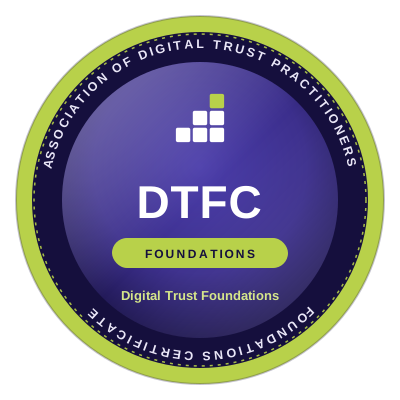 Foundation
DTFC
Digital Trust Foundations Certificate
For anyone new to digital trust.
 Core
CDTP
Certified Digital Trust Practitioner
For practitioners who run trust work day to day.
 Specialization
CPTP
Certified Privacy Trust Practitioner
For people who run privacy operations.
 Specialization
CTTP
Certified Third-Party Trust Practitioner
For people who own vendor and third-party risk.
 Specialization
CATP
Certified AI Trust Practitioner
For people who govern how AI is used.
Nothing is granted silently.
One ADTP Learning Credit is about an hour of assessed effort. Credits fill a credential map by domain. A credential always requires a separate examination, for every member, at every tier.
Take a course
A certificate with a verification ID and its credit value, issued on completion.
Accumulate credits
Your credential map fills by competency domain, showing exactly what remains.
Sit the examination
Meet the published eligibility, pass the examination, hold a publicly verifiable credential.
Recognition should mean something.
Four things that are routinely confused, kept deliberately separate.
Reading the framework, the glossary or the intelligence feed. Open to anyone.
Nothing requiredBelonging to the Association and holding access to its curriculum and resources.
JoinA record that specific learning was completed, with a verification ID and credit value.
Complete the courseA demonstration of capability against published requirements, verifiable by anyone.
Pass the examinationYou can tell them apart without reading them. The shape is the category.

A common foundation for digital trust.
The Digital Trust Common Framework gives one control language across the standards and obligations practitioners meet in their work. It is published by the Association as an open professional resource.
The purpose is not another framework to memorize. It is to make it easier to see where established frameworks agree, where they part company, and what either fact means on a Tuesday afternoon.
Resources for the profession.
A good deal of it is free, and stays free. A common professional vocabulary should not depend on the ability to pay for it, and neither should finding out whether this work is for you.
Forty-five documents, written to be adopted rather than admired.
Policy and standard templates for your organization, mapped to the frameworks you are actually assessed against, with the gaps marked rather than papered over. Previews are open to everyone; the editable set comes with membership.
Open the libraryOne subject, worked through properly.
Written for the decision rather than the headline: what a finding actually means, and what you do about it on Monday. No account, no paywall, no email required to read it.
Read the latestSpaced repetition across every certification we cover.
The first five cards of every domain are free on every pathway, so any exam can be tried without paying for it. Membership opens the full deck and the scheduling, which is the part that makes them work.
Pick a pathwayBlank artifacts you can use on Monday.
Access reviews, vendor tiering, risk acceptances, evidence calendars. The same artifacts our courses ask you to produce, without the course.
Browse templatesOne objective, many frameworks, honest gaps.
The Digital Trust Common Framework maps a single control objective across SOC 2, ISO, NIST, PCI, HIPAA, GDPR and the AI Act, and says where they genuinely do not line up. Download the whole thing under CC BY 4.0.
Explore the DTCFCurrent developments, read for their implications rather than their headlines.
Advisories and briefings written for risk decisions. Members set their own topics and severity thresholds.
Open the feedMembership in the Association.
Open to people already carrying trust governance responsibilities, and to professionals deliberately moving toward them from security, privacy, audit, risk, legal, compliance, IT and operations. Membership begins with an open entry tier; Practitioner memberships broaden access to the curriculum and professional resources.
Charter Practitioner
The Association is establishing its founding practitioner community. Those who join during this period may be invited to become Charter Practitioners, marking their membership during the founding. It is a membership designation, separate from the credentials earned by examination.
Read moreTeam membership
Seats, assignments and completion evidence for teams carrying these responsibilities together, including awareness training available only through an organization.
For organizationsAnyone can check a credential
Every certificate and credential carries an ID that resolves to a public verification page. No need to ask the holder, and no need to ask us. A record nobody can check is worth what it costs to print.
Verify a credentialA profession should travel with you.
Employers change. Roles change. Technologies change. Frameworks change. Professional capability should remain yours.